
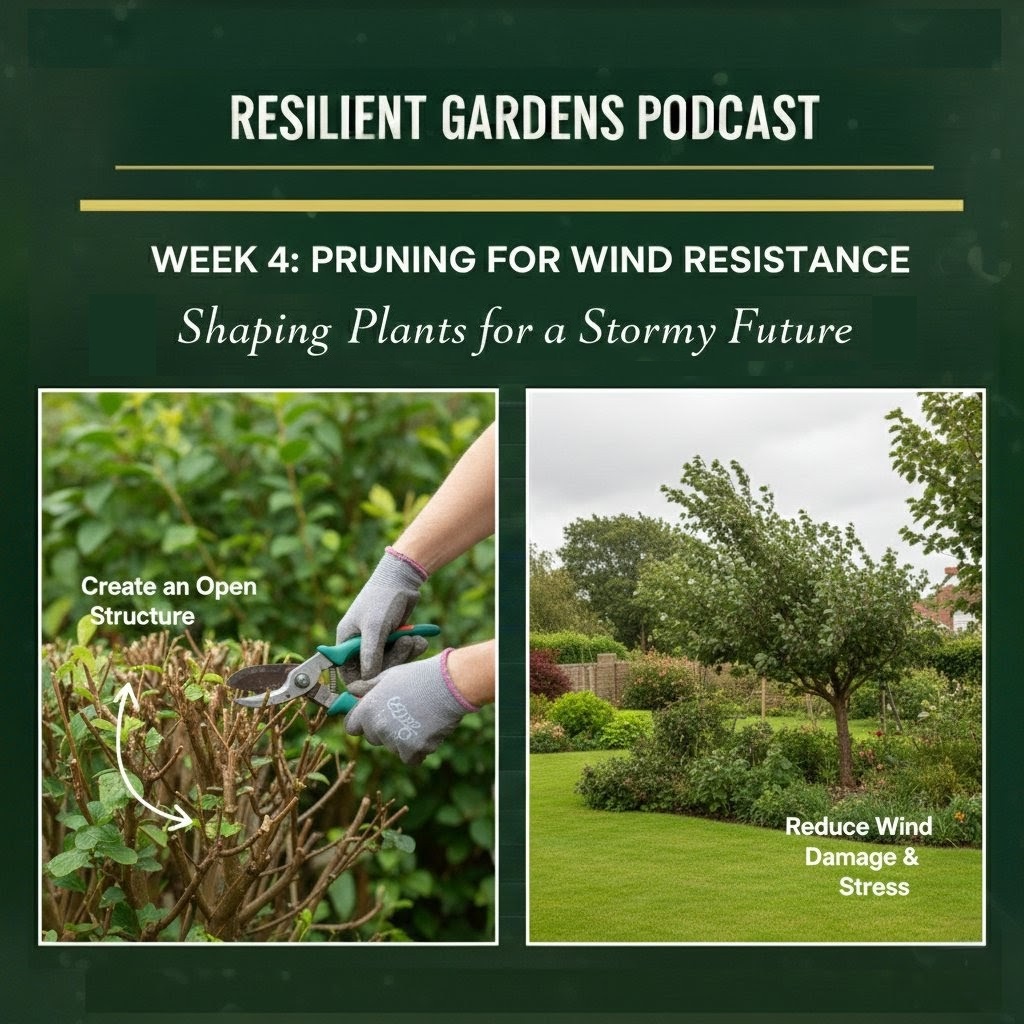
Why Your “Solid” Garden is a Storm Risk: The Counter-Intuitive Art of Wind-Pruning
Introduction: The Invisible Force
Welcome back to Week 4 of our resilient design series. Over the last three weeks, we’ve mapped out microclimates, engineered soil sponges to handle deluges, and secured our water supplies. But today, we address the silent, invisible force that can undo decades of growth in a single night: the wind.
In my 40 years as a horticultural consultant and member of The Gardeners Guild, I’ve seen countless “perfectly” manicured gardens decimated by seasonal gales. The traditional “set it and forget it” mindset is no longer a viable strategy in the UK’s increasingly unpredictable climate. To build a truly resilient landscape, we must stop trying to block the wind and start learning how to dance with it.
The “Sail Effect”: Why Dense Hedges Fail
It is a common instinct for homeowners to crave dense, “solid” evergreen walls for privacy and a perceived sense of security. However, from the perspective of physics, these hedges are a massive liability.
A thick evergreen acts exactly like a sail on a ship. When a storm hits, the wind cannot pass through the foliage, so it pushes against the entire mass with immense pressure. This “sail effect” is what leads to snapped trunks and uprooted specimens that often take fences and property down with them.
“A garden that bends is a garden that stays.”
True resilience requires permeability. We need to move away from the “solid wall” philosophy and instead transform our plants into permeable filters that allow air to flow through rather than against them.
The ResilientGardens 1-2-3 Action Plan: 1x Structural Focus
To improve the aerodynamics of your garden, you must move beyond surface-level aesthetics. Your primary goal is to reduce wind resistance in your largest evergreens and dense deciduous shrubs.
- Thinning Cuts vs. Heading Cuts: Most gardeners use “Heading Cuts”—shearing the outer tips of branches. This is a mistake for storm prep, as it actually stimulates thicker growth on the exterior, making your “sail” even heavier. Instead, use Thinning Cuts. Reach deep into the center of the plant and remove select branches entirely, cutting them back to the main stem or a strong lateral branch.
- Creating “Windows”: Your visual objective is to create “windows” within the canopy. After pruning, step back and look through the plant. You should be able to see dappled light appearing through the foliage.
- The Physics: By thinning the interior, you break up the solid mass. This significantly reduces the leverage the wind exerts on the root system, keeping the plant anchored when the gusts pick up.
2x Maintenance Wins: Shortening the “Lever Arm”
The first of our proactive maintenance wins focuses on reducing the physical stress on individual limbs.
Identify the heavy, horizontal branches on your shrubs and trees. During a storm, these limbs act as “lever arms.” The longer the branch, the more force the wind can apply to the joint where the branch meets the trunk. By performing a Weight Relief Snip—shortening these long limbs back to a strong lateral branch—you drastically reduce that leverage. This simple mechanical adjustment makes it significantly harder for the wind and heavy rain to snap the branch at its base.
2x Maintenance Wins: Defeating the “Vortex Effect”
The second maintenance win involves Crown Raising, a technique critical for plants located near boundary walls or fences.
When a shrub’s foliage extends all the way to the ground near a solid wall, wind becomes trapped in the gap. This creates a “Vortex Effect”—a pocket of high-pressure turbulence that bounces off the wall and swirls violently, often destabilizing the plant from the bottom up. By pruning away the lowest branches to clear the ground, you allow the wind to pass safely underneath the plant. This simple clearance ensures that air moves freely across your boundaries rather than becoming a destructive force.
3x Climate-Hero Plants: The Wind-Dancers
Strategic pruning is easier when you start with species naturally adapted to high-wind environments. Here are my top three picks for a resilient UK garden:
- Betula utilis jacquemontii (Silver Birch): A master of flexibility. Instead of resisting the wind with rigid wood, the Silver Birch sways and bends, while its airy canopy naturally allows the gale to pass through with minimal resistance.
- Griselinia littoralis: The ultimate coastal champion. It provides a lush evergreen screen, but its leathery, flexible leaves are uniquely resistant to “scorch” or tearing, even in salt-laden Atlantic winds.
- Crataegus monogyna (Hawthorn): This is the “buffer specialist.” Its intricate, dense branch structure acts as a natural filter, breaking powerful gusts into thousands of small, harmless eddies. It is the ideal plant to use as a protective windbreak for more delicate species.
Conclusion: Shaping Success for the Next Storm
Protecting your garden is about shifting your perspective. A resilient garden is not a fortress; it is a dynamic system designed to filter the storm. By spending a few hours today with your loppers and secateurs, you are ensuring that your garden can weather the blast while you stay safe and dry inside.
Take a look at your boundaries: is your garden currently a “sail” catching the full force of the gale, or is it a “filter” designed to let the wind dance through?