
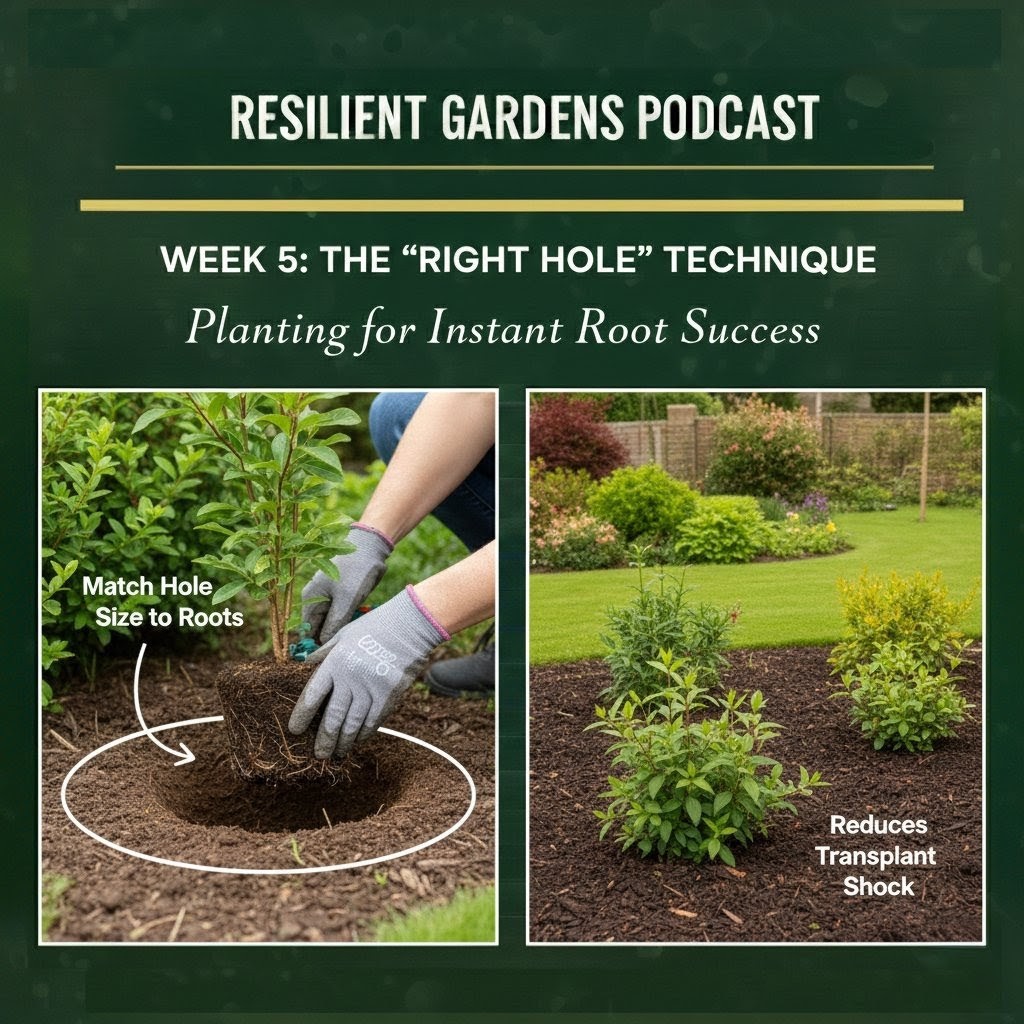
Why Your Garden is Failing in the First 10 Minutes (And the “Right Hole” Fix)
The Critical First Ten Minutes
If you think your latest garden addition died because of a mid-summer heatwave or a sudden frost three months after planting, you are likely mistaken. In my 40 years as a horticultural consultant and permaculture designer, I have witnessed a consistent, harsh reality: the fate of your plant is almost always sealed within the first ten minutes of it hitting the soil.
Most gardeners approach planting as a tidy chore, focusing on “neatness” rather than biology. This is a fundamental error. Traditional methods—the ones passed down through glossy magazines and outdated manuals—are often a death sentence for your greenery. At Resilient Gardens, we prioritize the architecture of the foundation over temporary aesthetics. If you want a landscape that survives the next decade of unpredictable climate extremes, you must stop “digging a hole” and start engineering a future.
Beware the “Sump Effect”
The single most common mistake I see is the “bucket” hole—a deep, narrow shaft that perfectly mirrors the shape of the nursery pot. While this satisfies a gardener’s desire for order, in heavy clay soil, it is lethal.
When you dig a smooth-sided hole in clay, you are effectively creating a ceramic pot underground. The walls become “glazed” and impermeable. This leads to the Sump Effect: during a wet British winter, the hole fills with water that has nowhere to escape, drowning the roots. Conversely, during a drought, those same hardened walls act as a cage, preventing roots from reaching outward for moisture. The plant eventually grows in circles, strangling itself in its own narrow prison.
“The smooth, vertical walls of the hole become glazed and impermeable. When it rains, water fills the hole like a bucket, drowns the roots, and cannot escape.”
Infrastructure Over Depth (The 2x Width Rule)
To build a resilient garden, you shall shift your focus from depth to horizontal infrastructure. We call this the 1x Structural Focus. Roots require a “Wide-Base Foundation” to anchor against high winds and forage for deep-earth nutrients.
- The Dimensions: You must dig your hole at least twice as wide as the root ball, but no deeper than the pot it came in. Depth is the enemy; width is the ally.
- The “Rough Up” (Non-Negotiable): Before the plant goes in, you must take a garden fork and aggressively score and scratch the sides of the hole. This is the most vital physical act in the process.
- The “Runway” Concept: Scoring breaks the clay glaze, opening up pathways for tiny root hairs to penetrate the surrounding earth. The extra width provides a “runway” of loosened soil, encouraging the plant to establish a stable, lateral anchor that can withstand the fiercest gales.
The Maintenance Hacks (Grit and Collars)
Once the structure is set, you will apply the 2x Maintenance Wins. These simple mechanical adjustments will halve your future workload and ensure the plant thrives without constant intervention.
- Win #1: The Grit-Drainage Hack. Never fill a hole in clay soil with pure compost. It acts like a sponge, holding far too much water and rotting the roots. Instead, you shall mix a generous handful of horticultural grit or sharp sand into your backfill soil. This creates “micro-drainage” channels that prevent the soil from compacting back into a solid block, ensuring vital oxygen reaches the roots even during the wettest seasons.
- Win #2: The Watering Collar. When backfilling, do not flatten the earth into a smooth plane. Instead, build a “doughnut” or “collar” of soil around the outer edge of the planting hole. This acts as a natural funnel, ensuring every drop of rainwater—or the harvested soft water we worked so hard to collect in earlier stages—is directed straight to the root ball rather than running off the surface.
Recruit Your Climate-Hero Plants
To truly master a resilient landscape, you should utilize 3x Climate-Hero Plants. These species are biological specialists designed to thrive in the “Right Hole” and punch through difficult conditions.
- The Clay-Breaker: Rosa rugosa (Rugosa Rose) Unlike its delicate, high-maintenance cousins, the Rugosa is a powerhouse. Its aggressive root system is designed to punch through heavy soil, making it exceptionally drought-tolerant once it finds its footing.
- The Anchor Specialist: Quercus robur (English Oak) If you have the space, the Oak is the king of resilience. Its deep taproot system, combined with a wide lateral spread, makes it nearly impossible to uproot when planted using the “2x Width” technique.
- The Drought-Defier: Perovskia atriplicifolia (Russian Sage) A specialist for “Scorch Zones.” It establishes a deep, woody root system with remarkable speed, remaining vibrant and silver-blue even when the rest of the garden is parched and gasping.
The “Five-Pound Hole” Philosophy
The transition to a resilient garden is, at its heart, a shift in your philosophy. You are moving away from being a “nurse” to your plants—constantly hovering with fertilizers and hoses—and becoming a curator of a self-sustaining system.
The guiding principle of my 40-year career is this:
“Dig a five-pound hole for a one-pound plant.”
It takes ten extra minutes to widen that hole and score those clay walls, but those ten minutes buy you ten years of peace of mind. You are not just planting a flower or a tree; you are building an organism capable of taking care of itself.
Building for the Next Decade
By mastering the architecture of the planting hole, you are building a legacy. You are creating a garden that doesn’t just survive but thrives amidst the extremes of the coming decade. Spend your time practicing the “Wide-Base” technique: twice the width, scratch the sides, and build that water collar.
As you look at your landscape today, ask yourself: is it built to withstand the next ten years of environmental shifts, or is it just waiting for the next big storm to fail?