
Stop Paving Your Problems Away: Why Your “Low-Maintenance” Garden is Making Your House Hotter
After 40 years as a horticultural consultant and permaculture designer, I’ve seen the “rules” of gardening shift dramatically. For decades, if you wanted a low-maintenance outdoor space, the standard advice was simple: pave it over. As the founder of Resilient Gardens and Morpheus Garden Care, and a registered member of The Gardeners Guild, I am here to tell you that this old-school fix has become a dangerous liability.
Welcome to Week 15 of our series. Today, we’re tackling the low-maintenance trap. In an era of unpredictable climate extremes—from searing heatwaves to sudden flash floods—a garden sealed by concrete or stone cannot function. To protect your home, your garden needs to “breathe and drink.” We need to move away from viewing the garden as a static, dead surface and start seeing it as a living system designed to manage water and temperature.
Your Patio is a “Heat Battery”
The most immediate impact of traditional hardscaping is the intensification of the “Urban Heat Island” effect. Solid surfaces like concrete, asphalt, and standard paving slabs are incredibly efficient at absorbing solar energy. Throughout the day, these materials soak up heat, and long after the sun goes down, they radiate it back into the environment.
In my design practice, I’ve observed how this directly affects the home. When your patio is radiating heat back at your windows and walls all night, your living space never truly cools down. You aren’t just installing a path; you are installing a radiator that runs 24/7.
“At ResilientGardens.co.uk, we call traditional paving ‘heat batteries’ and ‘flood triggers.'”
The ResilientGardens 1-2-3 Action Plan
To help your garden breathe and drink, I’ve developed a straightforward framework to transition your property from a liability into an asset.
Step 1: Structural Focus (The Soil Sponge)
The primary goal of a resilient garden is to transition from “runoff” surfaces to “infiltration” surfaces. During the flash floods that now characterize our summers, rain hitting solid paving has nowhere to go but the street, overwhelming local drainage systems.
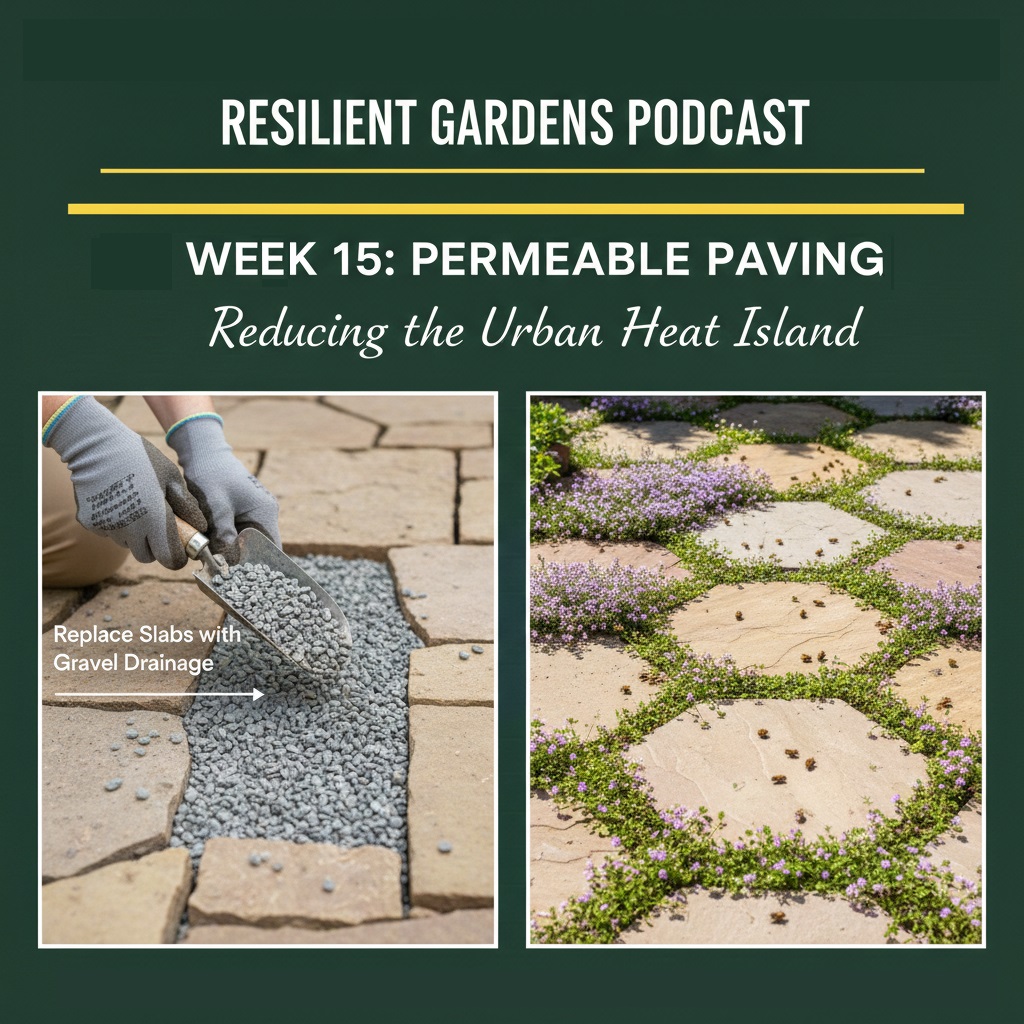
In my 40 years of experience, I’ve found that resilience starts when we replace non-porous slabs with aggregates like gravel or permeable cellular paving. This turns your paths and patios into a “soil sponge.” These surfaces feature gaps that allow water to soak directly into the ground, recharging the groundwater and—crucially—keeping the biology of the soil beneath the path alive and healthy.
The Climate-Hero Goal: Ensure 100% of rainfall stays on your property. By keeping the water on-site, you slow the flow into overtaxed drains and cool the local air through natural evaporation.
Step 2: Maintenance Wins (The “Self-Weeding” Path & Green Gaps)
One of the biggest hurdles I hear from clients regarding gravel is the fear of maintenance. However, the “Self-Weeding Path” is entirely possible if you choose the right materials.
Many people use rounded “pea shingle,” which moves around and provides the perfect pocket for weed seeds to settle. I always recommend sharp angular grit instead. The jagged edges of angular grit allow the stones to mechanically “lock” together. This creates a stable walking surface that is significantly harder for weed seeds to penetrate. It’s a cleaner, sharper look that requires far less physical labor.
The second maintenance win is what I call “Green Gaps.” Instead of using mortar or grout to seal the joints between large stepping stones—which eventually cracks and invites weeds anyway—we fill those joints with life.
Step 3: Climate-Hero Plants (The Steppable Coolers)
When you use “Green Paving,” you are installing mini-coolers. Through the process of transpiration, these plants release moisture into the air, actively lowering the temperature of the path surface. If you want a path that survives both foot traffic and heat, I recommend these three heroes:
- The Scented Specialist: Thymus serpyllum (Creeping Thyme). This is incredibly drought-tolerant and thrives on the heat reflected by stones. Beyond the Mediterranean scent it releases when stepped upon, it serves as a vital nectar source for bees.
- The Moss Mimic: Sagina subulata (Irish Moss). This isn’t a true moss, which means it handles full sun much better than the real thing, which would normally scorch. it creates a lush green carpet that holds moisture in the soil and keeps ground temperatures low.
- The Tough Carpet: Leptinella squalida (Brass Buttons). This fern-like groundcover forms a dense mat that is perfect for blocking weed growth in permeable joints. Most importantly, it stays green even when the surrounding garden is dry.
Conclusion: Let the Earth Breathe Again
The future of your home depends on resilience. We must move toward designs that allow our properties to handle environmental extremes rather than fighting against them. My mantra at Resilient Gardens remains: “Don’t pave over your problems; plant through them.”
I challenge you to identify just one area of solid paving you can “break open” this week. Whether it is a small garden path or a corner of your patio, replacing it with a permeable alternative is a vital step in future-proofing your home. Is your garden helping you stay cool, or is it acting as a battery for the next heatwave?