
Why Your “Sun Trap” is Stressing Your Garden (And the 10°C Solution)
Many gardeners spend a lifetime chasing the dream of a “sun trap”—a south-facing expanse of stone, dark decking, or pristine lawn designed to drink in every available ray. In the gentle, honeyed light of May, these spaces are a delight. But by the height of July, the reality is far harsher. You’ve likely felt it: the blinding glare off the patio, the smell of scorched earth, and the sight of expensive perennials wilting despite your best efforts with the hose. Without a canopy to intercept that energy, your sanctuary becomes a radiator.
I am Graeme Farrer, founder of Resilient Gardens and a registered member of The Gardeners Guild. In my 40 years on the spade, I have seen the “old rules” of British gardening crumble in the face of our changing climate. We no longer just garden for the weekend; we garden for resilience against punishing heatwaves and the sudden, erosive power of flash floods. My mission is to show you that shade isn’t a “problem area” to be avoided. It is a vital, natural parasol—your garden’s primary form of biological air conditioning.
The 10°C Cooling Power of Transpiration
In a professionally designed garden, strategic tree placement isn’t just about aesthetics; it’s about physics. High-quality data shows that a well-placed canopy can lower ground temperatures by as much as 10°C. To understand why, we must look at the difference between “passive” and “active” cooling.
A stone patio or a dark fence acts as a thermal mass. It absorbs solar radiation all day and pumps it back into the air long after the sun has set, keeping your garden uncomfortably hot into the night. A tree, however, is a living machine. Through a process called transpiration, a tree pulls water from the deep soil and releases it through its leaves. This isn’t just shade; the evaporation process actively consumes heat energy, chilling the surrounding air. While a patio umbrella merely blocks the light, a tree actively lowers the temperature of the breeze that drifts into your home.
——————————————————————————–
The ResilientGardens 1-2-3 Action Plan
Following our look at wall-cooling climbers in Week 9, we are now expanding our cooling canopy to the entire site. Here is my framework for installing a permanent, living cooling system.
1x Structural Focus: The Southern Intercept
To stop your garden from baking, you must identify your “Heat Anchors”—the specific surfaces that absorb the most punishment. These are usually stone patios, dark-painted fences, or large south-facing windows.
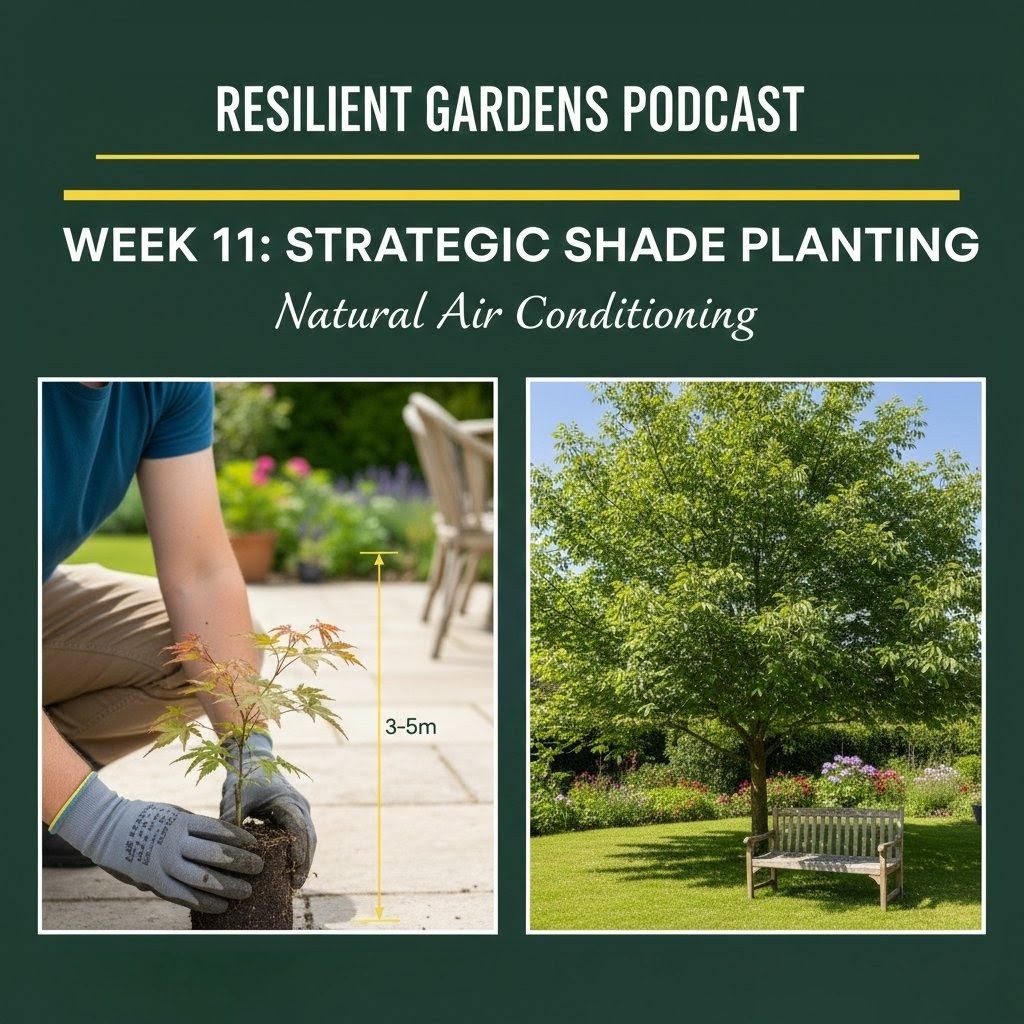
The most effective strategy is the Southern Intercept. I recommend planting small, deciduous trees roughly 3 to 5 meters away from your Heat Anchors on the south or southwest side of the property. The goal is surgical: you want to cast a shadow specifically during the peak heat hours of 1:00 PM to 4:00 PM. By intercepting those rays before they hit a hard surface, you prevent the buildup of thermal mass, keeping the entire “soil sponge” beneath much cooler.
“The best time to plant a shade tree was twenty years ago; the second best time is today.”
2x Maintenance Wins: The “Self-Cleaning” Mulch and the “Light Lift”
A resilient garden works with nature, not against it. By using trees, we gain two major maintenance advantages:
- The Leaf-Litter Bank: Many see autumn leaves as a chore to be raked and binned. In my practice, they are a “gift.” By blowing these leaves into “living mulch” zones, you create a rich layer of leaf mold. This insulates the soil sponge, feeding vital microbes and—crucially—acting as a buffer during flash floods by slowing water runoff and increasing soil absorption.
- The “Light Lift” (Crown Thinning): Gardeners often fear trees will create “dark zones” where nothing grows. The hallmark of a professional design is balance. By thinning the inner branches of your trees every few years, you perform a “Light Lift.” This allows dappled sunlight to filter through, providing enough light for an understory of plants to thrive while maintaining the cooling canopy. It’s the perfect harmony of light and life.
3x Climate-Hero Plants: The Precision Shade-Makers
For the modern UK garden, where space is often limited, you need trees that provide high-quality shade without outgrowing their welcome. Here are my top three recommendations:
- Sorbus aucuparia (Rowan/Mountain Ash): A resilient native and a permaculture favorite. Its feathery, compound leaves create a soft, dappled shade rather than a heavy gloom. It is incredibly tough against wind and provides a late-summer feast of berries for birds.
- Acer palmatum (Japanese Maple): The master of the small-space canopy. Acers offer dense, layered foliage that is exceptionally effective at blocking solar radiation. Importantly, their roots are non-aggressive, making them safe to plant near patio foundations or “Heat Anchor” walls.
- Amelanchier lamarckii (Juneberry): I call this the “Cloud Tree.” It is a multi-season hero, offering clouds of white flowers in spring, delicious berries in summer, and spectacular autumn color. Its airy canopy cools a seating area without ever making it feel claustrophobic.
Conclusion: The 3PM Challenge
Transforming your garden from a “baked” environment into a resilient one requires a shift toward vertical thinking. You aren’t just planting a tree; you are installing a permanent, carbon-sequestering cooling system that protects your soil and your family’s comfort.
I challenge you to observe the invisible energy of your garden this week. Take a walk outside and see where the sun hits your patio at 3PM. That is the exact spot where your “natural parasol” belongs.