
Stop Guessing, Start Growing: The Surprising Secret to a Zero-Struggle Garden
The Curse of the “Memory Fade” Trap
We have reached the finish line. This marks the end of our 32-week Resilience Kickstart, a journey where we’ve moved beyond mere “gardening” and into the realm of true land stewardship. But as the season winds down, a subtle danger lurks: the “Memory Fade” trap.
By the time next May rolls around, the visceral sting of summer’s challenges will have softened. You will likely forget the acrid smell of baked, cracking clay on the patio or the sight of the silvered, crispy leaves of a hydrangea gasping in the August heat. Without a record, we are doomed to repeat the cycle—buying the same “thirsty” plants for the same scorched corners or neglecting the very spots that cried out for protection.
After 40 years in the field, I can tell you that the most vital act of gardening doesn’t happen with a tool in hand; it happens with a sharp eye and a quiet mind. To build a landscape that survives flash floods and heatwaves with grace, you must capture the “lived experience” of your soil while the evidence is still etched into the earth.
Your Best Tool is Observation, Not a Spade
It is time to hang up the gloves of frustration. Moving away from the exhausting cycle of “trial and error” requires a fundamental shift in how you view your role. You are no longer just a laborer; you are an auditor of performance. When you stop guessing why a plant failed and start observing the patterns of your site, you begin to design a garden that works for you, rather than one that demands you work for it.
“The most important tool in a gardener’s shed isn’t a spade—it’s Observation.”
The “Photo-Map” — Why Your Camera is a Design Power-Tool
To truly see your garden, you must map its “Topography of Resilience.” This isn’t just about where things are; it’s about uncovering the invisible energy patterns—the wind tunnels, the heat sinks, and the drainage routes—that define your success.
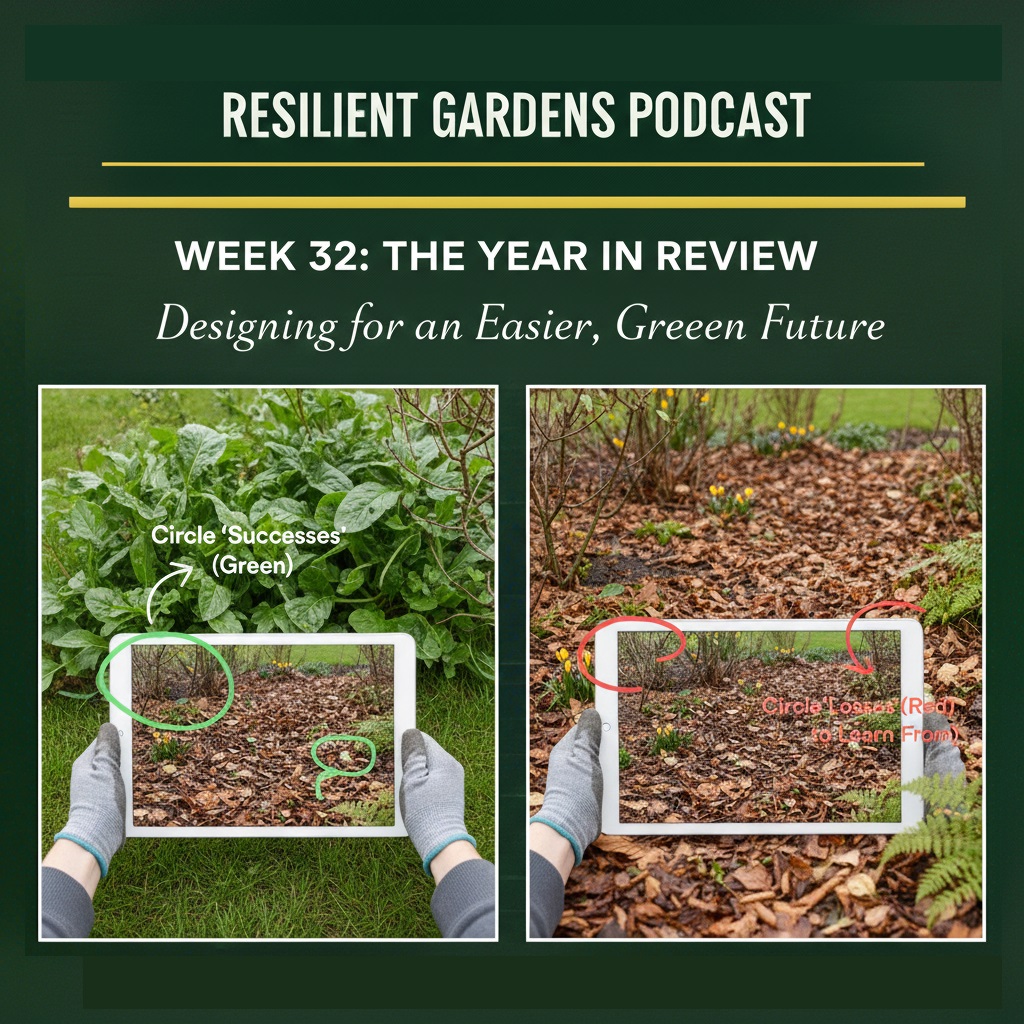
- The Action: Create a Photo-Map. Take wide-angle photos of every border and container. Using a digital markup tool or a physical printout, circle your successes in Green and your losses or struggles in Red.
- The Goal: Identifying the permanent patterns of light, water, and heat that dictate plant health.
- Why It Works: Photos don’t lie. A “Red” circle over a plant that has languished for three seasons is a clear signal of a structural mismatch. Conversely, any plant that thrived in a “Green” zone with zero intervention is your “Climate-Hero”—the genetic blueprint for that specific microclimate.
The “Ruthless Edit” — Ending the Relationship with Struggling Plants
Look closely at those “Red” circles. The “Ruthless Edit” is about mercy—both for the plant and for yourself. Instead of wasting your precious time and gallons of water trying to “save” a specimen that is fundamentally mismatched to its home, decide now to move it or replace it with a proven survivor.
Look back to the “Climate-Heroes” we identified in Week 24 or 26. By ending the struggle with mismatched plants today, you eliminate hours of future maintenance. A resilient garden is built on a foundation of plants that want to be there.
The Performance Audit — Testing Your “Soil Sponge”
A resilient garden must function like a sponge, and your mulch is its skin. This week, perform a “Mulch Check” to see how your interventions from Week 13 and Week 31 held up against the elements.
Ask yourself: Did your mulch stay in place during the heavy winter rains, or did it wash away? If it vanished, you’re looking at high-velocity runoff that needs to be slowed and sunk. This is your signal to revisit your “Permeable Paving” (Week 15) strategies or switch to a heavier, more interlocking mulch material. If the mulch stayed and kept the soil beneath it moist and friable, you’ve successfully protected your “Soil Sponge.”
The Three Pillars of the “Climate-Hero” Mindset
As we conclude this Kickstart, carry these three pillars of the Resilient Gardener with you as your manifesto:
- Work with the Site, Not Against It: If a corner is naturally dry and rocky, do not fight nature with a hose. Embrace the rugged beauty of the “Savanna Look.” Planting grasses and succulents that thrive in lean conditions creates an aesthetic that is both stunning and self-sufficient.
- Density is Your Friend: Stability in nature comes from layers. From the subterranean “soil sponge” to the towering tree canopy, a dense garden is a self-regulating microclimate. Remember: “Bare soil is your only true enemy.”
- Nature is the Best Maintenance Crew: Your job is to provide the “Biodiversity Housing.” When you recruit your “Biological Security Detail”—the ladybirds, frogs, and microbes—they will handle 90% of the pest control and soil health work for you.
Conclusion: A Continuing Conversation with the Earth
By mapping your successes and struggles today, you are doing more than just planning a garden; you are designing a future that is cooler, greener, and infinitely easier to manage. This process transforms your relationship with the land from a struggle into a collaborative partnership.
“A garden is never ‘finished’; it is a conversation between you and the earth.”
You now have the vocabulary and the framework to lead that conversation. As you look at your Photo-Map, ask yourself: Which “Red” circle in your garden is ready to be transformed into a “Green” success for next year?