
When the Mercury Redlines: The Counter-Intuitive Secret to Saving Your Scorched Garden
The “Survival Mode” Shift
Imagine standing in your garden as the thermometer climbs past 30°C. You watch your prized plants wilt, their leaves curling under the relentless sun, and your first instinct is to reach for the hose and the shears. But as a Permaculture designer with over 40 years in the dirt, I’m here to tell you that the old rules don’t just bend during a heatwave—they break.
I’m Graeme Farrer, founder of ResilientGardens.co.uk and Morpheus Garden Care. As a registered member of The Gardeners Guild, I’ve spent decades helping growers navigate the shift from a “thriving” garden to one in “survival mode.” In an era of unpredictable weather and record-breaking temperatures, standard gardening logic can actually do more harm than good.
To protect your sanctuary, we must move beyond aesthetics and embrace Emergency Heatwave Care. This is a tactical shift in mindset, utilizing my proprietary 1-2-3 Action Plan to ensure your garden doesn’t just endure the heat, but recovers from it.
1x Structural Focus: The Sub-Surface Direct Injector
During extreme heat, the soil surface acts like a hot plate. This triggers what I call the “Flash-Dry” Phenomenon: when you water with a traditional sprinkler or rose attachment, up to 50% of that water evaporates into the air or sizzles off the top layer of soil before it ever reaches a root.
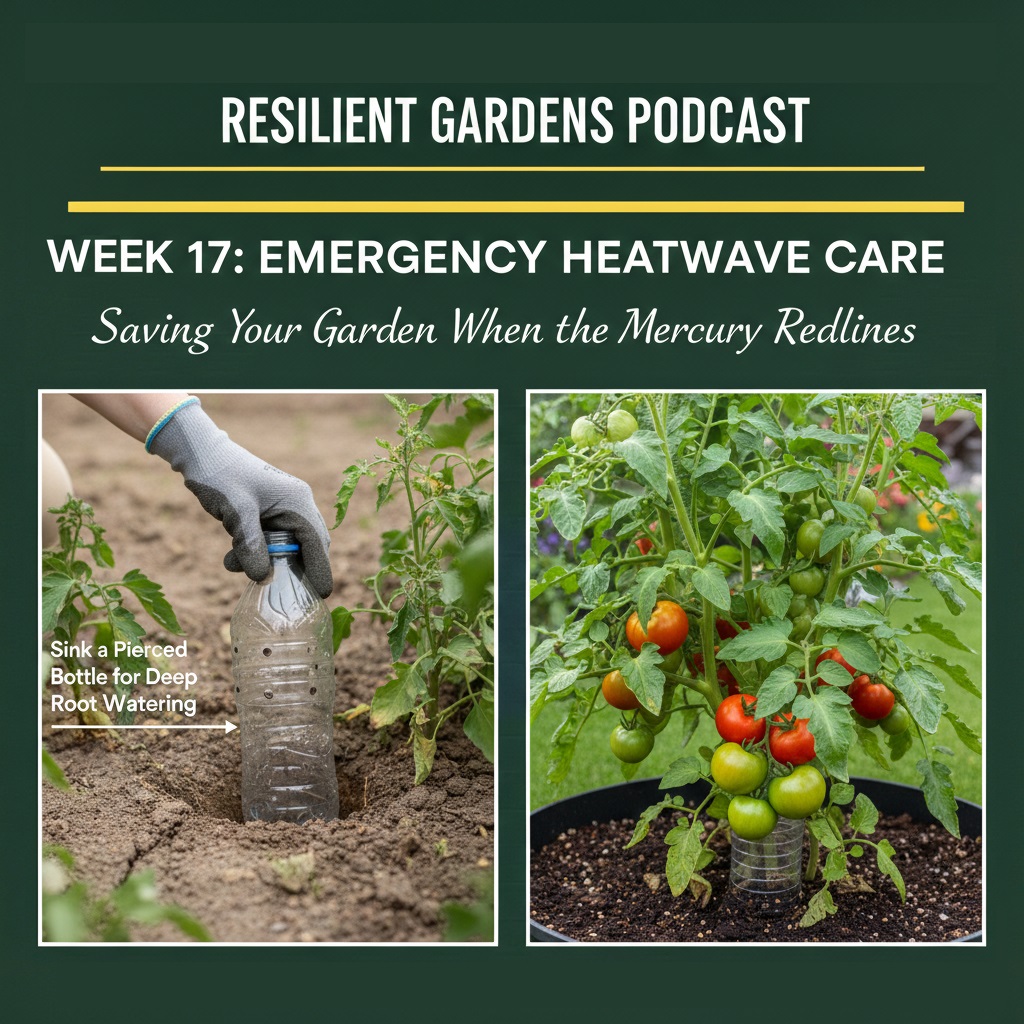
This leaves the “engine room” of the plant—the deep roots—completely parched. The result isn’t just leaf scorch; it leads to fruit drop and eventual plant collapse, effectively killing your harvest and your hard work. To bypass the surface heat, you must deliver water directly to the root zone using a Deep-Watering Reservoir:
- Take a plastic bottle and remove the cap.
- Cut off the bottom of the bottle.
- Pierce the sides of the bottle with small holes.
- The Critical Step: Sink the bottle deeply into the ground next to your thirstiest plants, ensuring the pierced holes are level with the root ball.
Analysis: By filling this “sink,” you force hydration to move laterally and downward, exactly where the engine room needs it. This keeps water away from the sun’s reach, preventing evaporation and encouraging roots to grow deeper into the cooler, protected earth.
2x Maintenance Wins: Triage and the “No-Prune” Protocol
When the mercury redlines, your maintenance routine requires two immediate “wins” to prevent total collapse.
Win #1: Strategic Shading Deployment of a “Temporary Screen” is your fastest defense. Between 11:00 AM and 3:00 PM, use everyday items like old bedsheets, shade cloths, or even umbrellas to shield high-value plants. Analysis: Lowering the leaf-surface temperature by just a few degrees can stop a plant from reaching its “permanent wilting point”—the biological threshold beyond which the plant’s internal structures fail and it cannot recover.
Win #2: The No-Prune Protocol I know how difficult it is to look at your garden when it looks “ugly.” Your “neatness instinct” will scream at you to prune away those crispy, brown, scorched leaves. I’ve stood where you are, watching roses crisp at the edges, and the urge to “tidy up” is powerful. But you must put down the shears.
Those scorched leaves are performing a final, heroic act: they are acting as a physical shield, providing vital shade for the green growth and delicate stems underneath. Removing them exposes the plant’s remaining lifeblood to direct solar radiation.
“In a heatwave, we aren’t looking for perfection; we are looking for survival.”
3x Climate-Hero Plants: The Heat-Resilient Anchors
While we fight to save the sensitive species, we must also look to the future by recruiting “Hero Plants” that use specialized biology to ignore the heat:
- Sedum (Stonecrop): These are desert specialists. Their thick, fleshy leaves are designed specifically for water storage, allowing them to remain turgid and green even when your lawn has turned to straw.
- Stachys byzantina (Lamb’s Ear): This plant wears its own armor. The tiny “silver hairs” reflect sunlight away from the leaf and trap a layer of cool air against the surface, creating a built-in micro-climate.
- Eryngium (Sea Holly): A master “Deep-Rooter.” It possesses a taproot that can extend over a meter into the ground, bypassing surface droughts entirely to pull moisture from deep underground reservoirs.
Conclusion: Triage and The Road Ahead
Emergency Heatwave Care is about prioritizing the biological engine over the aesthetic surface. Investing just five minutes today to install a few deep-watering reservoirs is the best insurance policy you can provide for a heat-stressed garden.
As we move deeper into this era of unpredictable weather, we have to ask ourselves: Is our garden a fragile ornament, or a resilient sanctuary? How will you adapt your landscape to ensure it survives the next time the mercury redlines?