
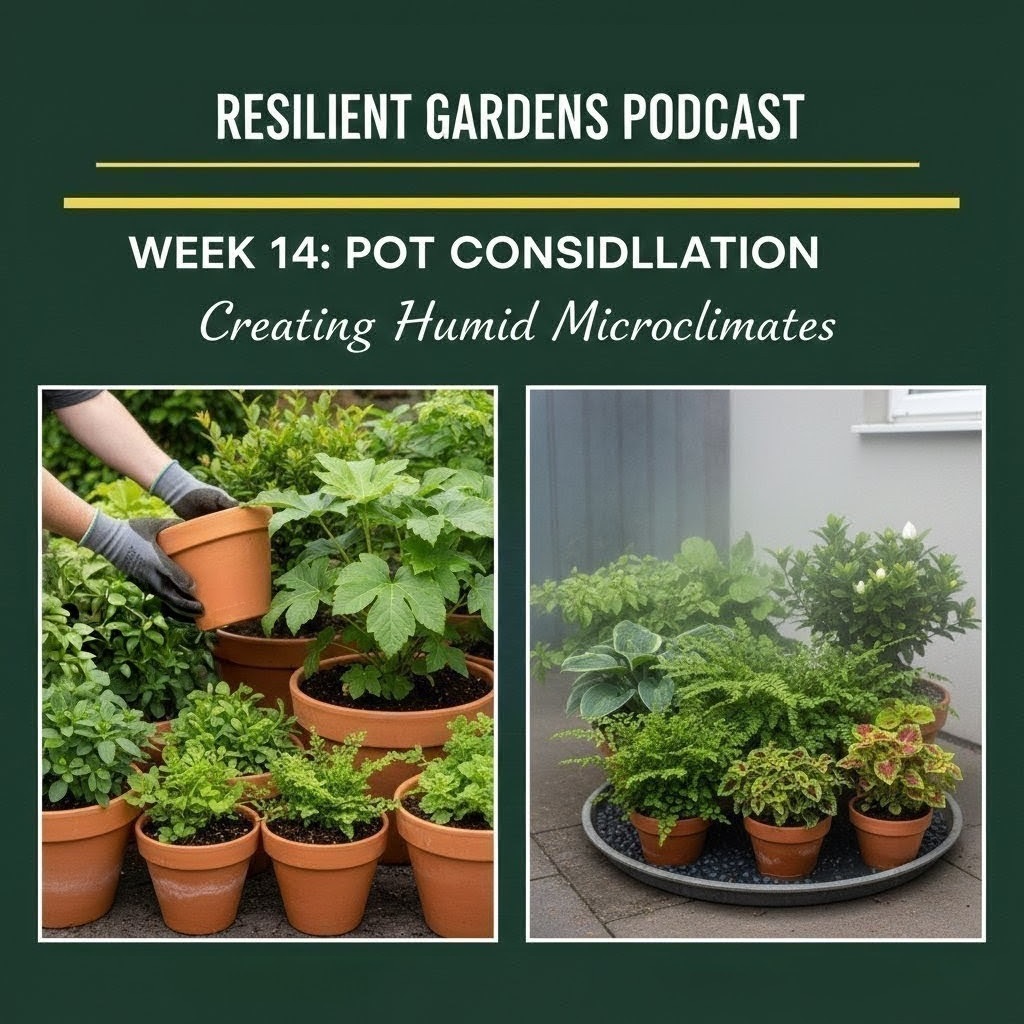
Why Your Potted Plants Are Dying Alone: The “Huddle” Hack for Summer Survival
Picture your patio in the peak of July: the stone flags are radiating heat like an oven, the air is bone-dry, and your favorite potted plants are looking “crispy” despite your best efforts with the watering can. As a horticultural consultant with over 40 years in the dirt, I’ve seen this heartbreak a thousand times. Most gardeners assume the sun is the only enemy, but the real threat is something much more subtle: isolation.
Welcome to Week 14 of our journey toward climate-ready gardening. I’m Graeme Farrer, founder of Resilient Gardens and Morpheus Garden Care. As a member of The Gardeners Guild, my mission is to move us away from the high-maintenance “struggle-bus” gardening of the past. Today, I want to share a “lazy” win—a simple tactical shift that uses basic physics to create a thriving, green oasis where others see a graveyard.
Stop the “Lone Soldier” Syndrome
In my four decades of design, I’ve learned one universal truth: a single pot standing alone on a hot patio is a plant in crisis. When a container is isolated, its root ball and foliage are exposed on all sides to dry wind and radiant heat from the ground and walls. This exposure forces the plant into an unsustainable cycle of transpiration.
Think of transpiration as the plant’s way of “breathing” out moisture. When a plant stands alone, the parched summer air carries that moisture away instantly, causing the plant to dump its water reserves just to stay cool. It’s a losing battle. By leaving your pots scattered, you are essentially asking them to survive a desert trek without a canteen.
Master the “Huddle” Formation
The most effective defense is a strategy I call Pot Consolidation. Instead of dotting your pots around like lone soldiers, move them together into a tight “Huddle” formation where the leaves of neighboring plants are almost touching.
When you do this, you aren’t just tidying up—you are engineering a “Living Microclimate.”
- The Strategy: Place your largest, thirstiest plants in the center of the group and ring the perimeter with smaller, tougher containers.
- The Physics: This formation creates a “humid bubble” or a “community shield.” By grouping the plants tightly, you trap the moisture they release. This increases the relative humidity within the huddle, which physically slows down the rate of transpiration. The plants in the center are effectively “insulated” from the elements by the collective breath of their neighbors.
The Power of the “North-Side Shift”
If you’re planning a weekend away, don’t just hope for the best. Utilize the “Shadow Move.” This involves relocating your entire consolidated huddle to the north side of your house or into the deep, cooling shade of a tree.
By removing the “solar load”—the direct energy from the sun—you can reduce a plant’s water requirements by up to 75%. In the shade, a consolidated group can often survive for several days on a single deep watering, as the moisture trapped within the huddle remains stable rather than evaporating into the ether.
Engineering a “Reservoir Base”
To add an extra layer of protection, you can build what I call a “Reservoir Base.” This is a simple evaporation tray made by filling a large, shallow tray with 2cm of gravel and topping it with water to just below the stone’s surface.
Place your consolidated huddle directly on top of the gravel. This creates an active upward moisture flow. As the water evaporates from the tray, it rises through the huddle, fighting against the downward solar heat and keeping the “humid bubble” charged. In a true emergency, the plants can even “wick” moisture up through the drainage holes of the pots. It’s a self-sustaining system that works while you’re putting your feet up.
Deploying Your “Climate-Hero” Anchors
Within your huddle, certain plants act as tactical anchors that benefit the entire community. Here are three of my favorites for a resilient summer:
- Fatsia japonica (Paperplant) – The Humidity Anchor: With its massive, glossy leaves, the Fatsia has a high transpiration rate. I use it as a centerpiece because it acts as a biological humidifier, pumping out moisture that helps keep its more delicate neighbors alive.
- Phyllostachys (Bamboo) – The Cooling Screen: Bamboo in pots can dry out in a heartbeat, but when placed on the sunny side of your huddle, its dense foliage serves as a vital windbreak and shade-screen for everything behind it.
- Dryopteris (Ferns) – The Sensitive Survivor: These usually crisp up in dry patio air. However, if you tuck them into the humid heart of a shaded huddle, you mimic the forest floor, allowing them to thrive even in a scorching August.
Conclusion: Strength in Numbers
The fundamental philosophy at Resilient Gardens is simple: “A plant alone is a plant at risk.” Pot consolidation is the ultimate “lazy” win—it’s about working with the laws of physics rather than fighting a constant, uphill battle against the sun.
As you look out at your patio today, ask yourself: which of your “lone soldiers” is most at risk right now, and where will you move them to find safety in the huddle? By reorganizing your space to work with nature, you create a garden that doesn’t just survive the summer—it thrives in it.