
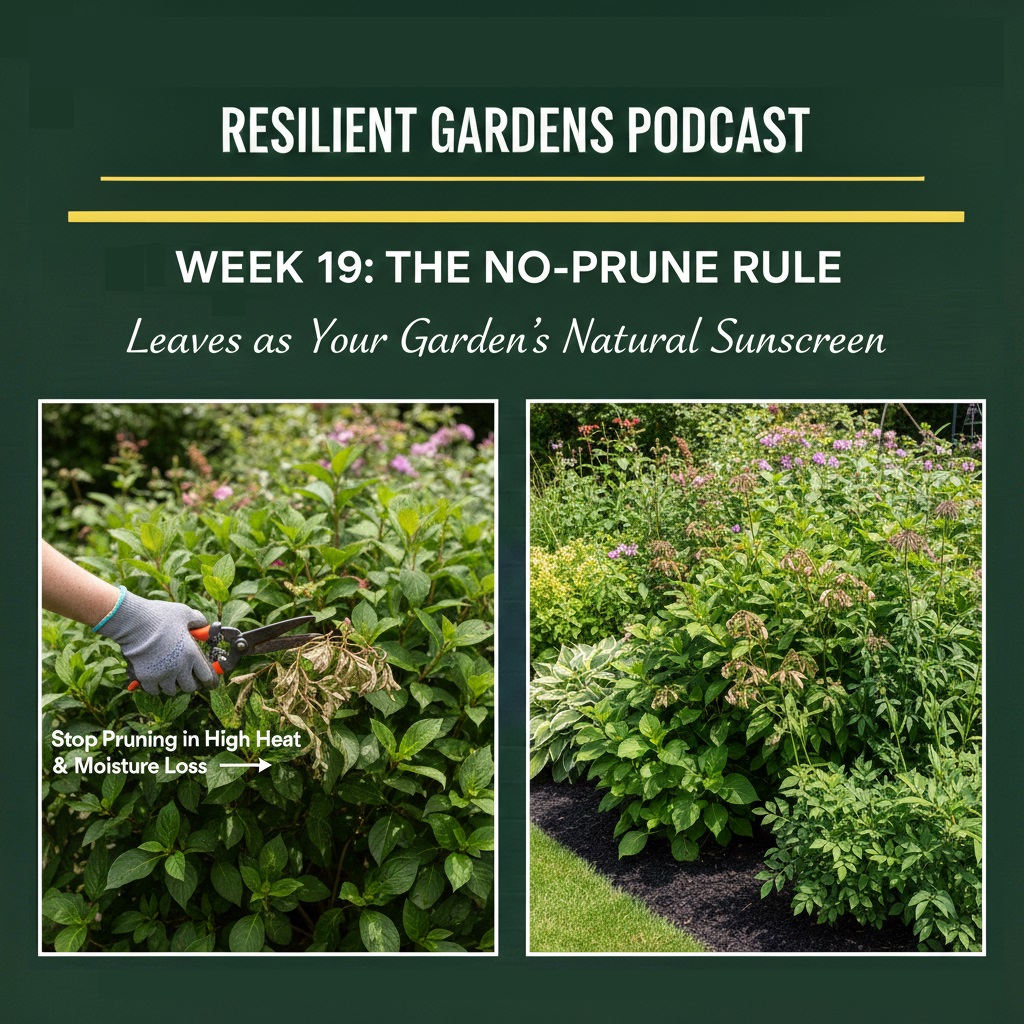
Stop Pruning: Why Your Secateurs Are Your Garden’s Worst Enemy This Summer
The “Tidying” Trap
For many, the sight of a stray branch or an unruly shrub triggers an almost pavlovian reflex: we reach for the secateurs. We have been conditioned to believe that “good gardening” is synonymous with a neat, manicured aesthetic. However, in my four decades of observation as a horticultural consultant and permaculture designer, I have found that plants possess a structural intelligence far superior to our aesthetic whims.
As we navigate Week 19 of our seasonal framework at Resilient Gardens, we must acknowledge that the traditional rules of the “British summer” are dissolving. In an era defined by aggressive heatwaves and erratic flash floods, the drive to “tidy up” can be a death sentence for your greenery. Modern gardening requires a high-level tactical shift where plant health takes precedence over “tidiness.” This summer, I am asking you to adopt the “No-Prune Rule.” Sometimes, the most sophisticated gardening you can do is absolutely nothing at all.
The Biological Heat Shield and the 25°C Rule
During the height of summer, a plant’s foliage does far more than just photosynthesize; it functions as a sophisticated, biological heat shield. The outer canopy acts as a sacrificial barrier, absorbing the brunt of the sun’s intensity to safeguard the delicate vascular systems within. If you see the outer leaves browning or wilting, do not reach for the shears—that is the shield working as intended.
To protect your garden’s long-term health, I am issuing a high-level tactical command:
Impose a total Pruning Moratorium on all shrubs and trees whenever temperatures are forecast to rise above 25°C.
By maintaining the integrity of this natural “umbrella,” you preserve the “inner sanctum” of the plant. This creates a shaded microclimate—a pocket of cool, humid air—that keeps the sap flowing and prevents the bark from cracking under extreme solar stress. Removing this layer during a heat spike destroys the plant’s primary defense mechanism.
The Hidden Threat of “Stem-Burn”
The biological imperative behind the “No-Prune Rule” lies in the vulnerability of the plant’s internal anatomy. While the outer leaves have “hardened” to withstand UV radiation, the interior stems and younger shoots are soft and unadapted. When you prune away the exterior growth in mid-summer, you suddenly expose these sensitive internal structures to direct, unforgiving UV light.
The consequence is a phenomenon that can cripple a plant’s ability to hydrate itself, even if the soil is damp:
“This can lead to stem burn, where the plant’s ‘plumbing’ is effectively cauterized by the heat, preventing water from reaching the remaining foliage.”
The “Lazy Win” of Moisture Retention
Adopting a “No-Prune” stance offers two significant “Maintenance Wins.” These are high-leverage decisions that reduce your labor while exponentially increasing your garden’s resilience during a drought.
Win #1: Sealing the Pipes. Every cut you make on a living stem creates an open wound. In a heatwave, these wounds act as exit points for vital moisture. By keeping your tools in the shed, you are “sealing the pipes,” ensuring that every drop of water stays inside the plant’s vascular system where it belongs.
- Win #2: Avoiding the Thirsty “Flush.” Pruning is a biological trigger that commands a plant to produce new growth. During a heat spike, this is a catastrophic waste of resources. Forcing a plant to “spend” its limited water reserves on soft, new shoots—which have zero heat resistance and will likely wither within days—is a strategic error. Wait for the cooler days of autumn before asking your plants to invest energy in new foliage.
Meet the Self-Shading Specialists
Certain species are masters of architectural self-defense. At Resilient Gardens, we call these our “Climate-Heroes,” provided we don’t interfere with their natural engineering.
- Fagus sylvatica (Beech) – The Shade Architect: The Beech is a marvel of natural design; its leaves grow in flat, overlapping layers specifically arranged to catch light while keeping the trunk in total shade. Pruning these during the summer exposes the sensitive bark to devastating, permanent scorch.
- Laurus nobilis (Bay Laurel) – The Evergreen Shield: With thick, waxy leaves designed to reflect heat away from the plant, the Bay Laurel is built for the sun. Keeping the canopy dense is essential to protect the central trunk from drying out entirely.
- Hydrangea macrophylla – The Soft-Wood Survivor: These plants have exceptionally “watery” stems and rely entirely on their broad leaves to provide shade for their internal structures. Even if the leaves look “floppy” in the afternoon heat, do not be tempted to cut them back. This drooping is a defensive posture; the leaves are still performing their vital duty of shielding the plant’s core.
Conclusion: The Power of Doing Nothing
It is time we reframe our understanding of what a “successful” garden looks like in July and August. During a heatwave, “shagginess” is not a sign of neglect; it is a tactical choice that respects the plant’s own survival instincts. By letting those long branches cast their shadows, you are acting as a guardian rather than a corrector.
As I always tell my clients: “Sometimes the best gardening is the gardening you don’t do.”
Put your secateurs away and spend this week enjoying the natural resilience of your outdoor space.